
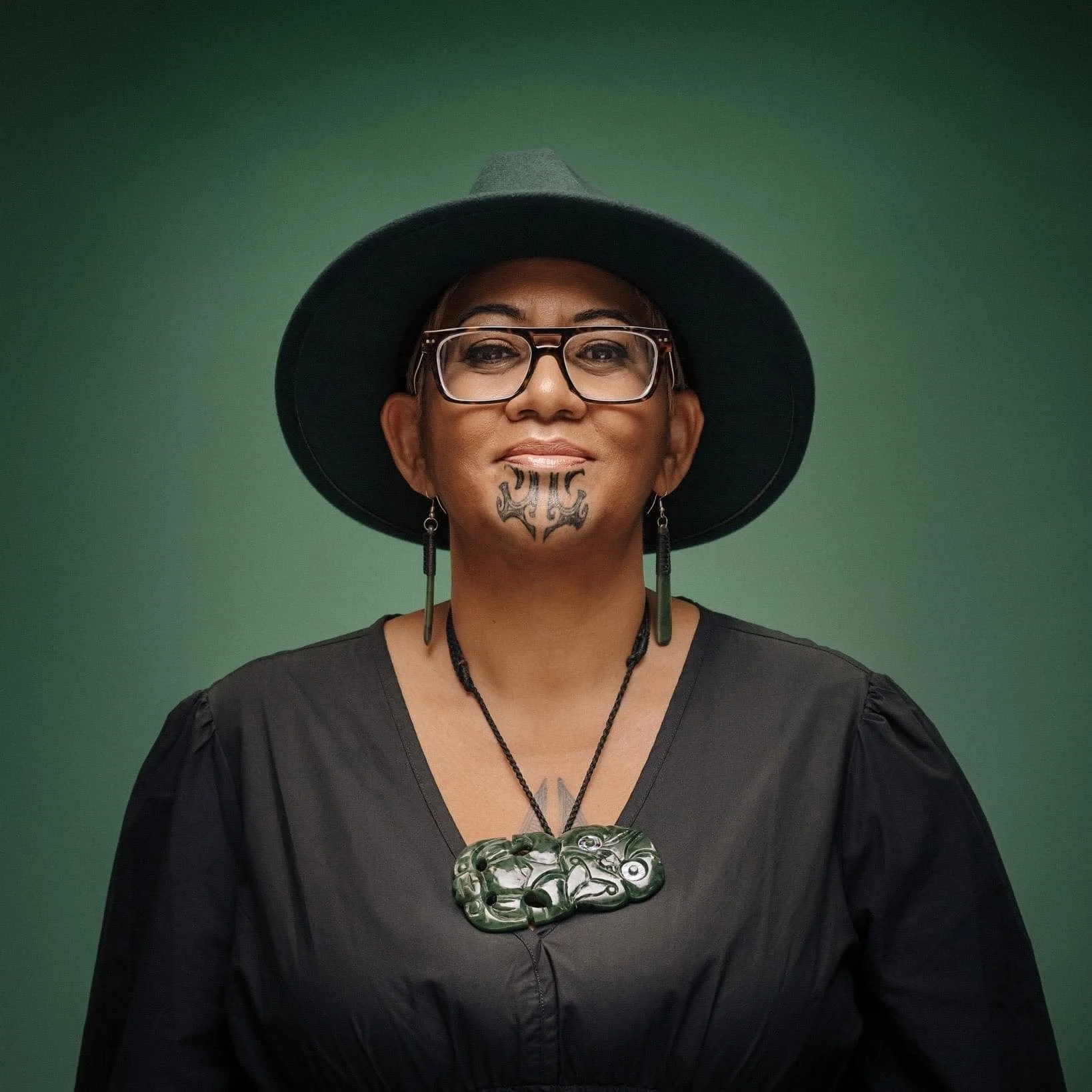
Takutai Tarsh Kemp
ONZM
(1975 – 2025)
She called herself a ringa raupā — a grassroots marae girl, born and bred. And she meant it not as humility, but as identity. As whakapapa. As the thing that made her who she was.
Takutai Moana Natasha Kemp was raised at Takirau marae in the Waitōtara Valley, South Taranaki, by her grandparents, her nana Takutai Moana, for whom she was named, and her papa Sonny, a composer of waiata and karakia. At ten years old she was already running the wharekai and looking after all the cousins. That is not a child growing up. That is a rangatira in training.
Her papa's marae was busy with taiaha, rongoā, waiata wānanga with Uncle Dalvanius Prime and Morvin Simon. Her whakapapa stretches across Ngā Rauru, Ngāti Pourua, Ngāti Tūwharetoa, Ngāti Tamakōpiri, Ngāti Hauiti, and Ngā iwi o Mōkai Pātea. Her great-grandmother's sister travelled with Tahu Potiki Wiremu Rātana on his world tour in 1924, carrying a petition on the Treaty of Waitangi to King George V. One hundred years later, Takutai was still fighting the same grievances from the floor of Parliament.
She came to Tāmaki Makaurau at fourteen. Left school early. Studied anthropology, health, and mātauranga Māori at the University of Auckland. Worked as a community health worker supporting teenage hapū māmā alongside mentor Syd Jackson, who told her: "Tarsh, look after your people, they in turn will do anything for you." She never forgot that.
She spent thirteen years as CEO of Te Kaha O Te Rangatahi, delivering sexual health education, alternative education, and a suicide prevention programme called talk2me, built on a simple belief that every young person mattered and deserved to be heard. She went on to lead Manurewa Marae, where her team delivered 65,000 vaccinations across Tāmaki Makaurau during COVID-19. One marae. Sixty-five thousand people. Because that is what you do when the system fails your whānau, you step up.
She was also, for twenty years, the heartbeat of hip hop in Aotearoa. Her children fell in love with dance. She became the dance mum, then the director of Hip Hop International New Zealand, then Hip Hop International South Pacific Islands. Dziah Dance Academy, the crew she built, became the first Aotearoa hip hop crew to represent at the World Hip Hop Championships in the USA. "Hip hop saved our lives as a whānau," she said. In 2021 she was made an Officer of the New Zealand Order of Merit for that mahi.
In 2023 she won the Tāmaki Makaurau electorate for Te Pāti Māori by 42 votes. She became spokesperson for social development, Whānau Ora, mental health, family and sexual violence, employment, kaumātua, and community affairs. She showed up every day, in the House, on the marae, in the community, even as kidney disease wore at her body. Her colleagues described her as the calm in the storm. She was in Parliament the day before she died.
She passed away on 26 June 2025, five days after turning fifty, in her sleep at home in Auckland.
"We are magic people," she told Parliament in her maiden speech. "We live in an Aotearoa hou. We will walk and talk, and we are proud to be Māori."
She is survived by her son Temanea, her daughter Tania-Jade, and her mokopuna Ludy-Anne. She has been taken home to Ōpaea Marae, Taihape, to her people.