
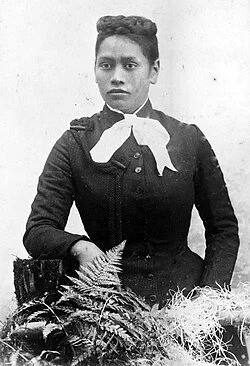
Meri Mangakāhia
(1868 – 1920)
Meri Te Tai Mangakāhia was born on 22 May 1868 in Lower Waihou near Panguru in the Hokianga valley — daughter of chief Re Te Tai of Te Rarawa, of Ngāti Te Rēinga, Ngāti Manawa, and Te Kaitutae descent. She was educated at St Mary's Convent in Auckland and was an accomplished pianist. She married Hāmiora Mangakāhia, an assessor in the Native Land Court who in June 1892 was elected the first Premier of Te Kotahitanga — the Māori Parliament.
She did not sit at the edges of that world. She moved through the centre of it.
On 18 May 1893, at the second session of Te Kotahitanga at Waipatu in Hawke's Bay, the Speaker of the lower house introduced a motion from Meri requesting that wāhine be given the right to participate in the selection of members. She was invited into the house to explain her motion. She walked in and became the first woman ever recorded to address Te Kotahitanga Parliament.
Her argument was not abstract. She asked not only that wāhine Māori be given the vote but that they be eligible to sit in the Māori Parliament — going further than the contemporary aims of the European suffrage movement. She argued that wāhine Māori had always owned and administered their own lands. She argued that colonisation had stripped them of rights they had always held. She argued that the Queen might more readily respond to representations made by other women. This was not a request for inclusion in someone else's system. It was an assertion that wāhine Māori had always held authority — and that no colonial law had the right to take that from them.
Ākenehi Tōmoana spoke after her, suggesting the matter be postponed until the men had achieved their goal first. The motion lapsed. It took four more years. Wāhine Māori did not win the right to vote in Kotahitanga elections until 1897.
But Meri did not stop. She helped establish Ngā Kōmiti Wāhine — committees associated with Te Kotahitanga addressing issues confronting wāhine Māori and their whānau, and early forerunners of the Māori Women's Welfare League. In partnership with Niniwa i te Rangi of Wairarapa she started Te Reiri Karamu — The Ladies' Column — in Te Tiupiri, The Jubilee. She wrote. She organised. She continued.
She died of influenza on 10 October 1920 — the same year New Zealand women stood for Parliament for the first time. She did not live to see everything she had fought for. But the ground she stood on in that room in 1893 is the ground wāhine Māori have been building on ever since.
She was not asking for something new. She was naming a theft. And she did it out loud, in a room full of men, for the first time in history.