
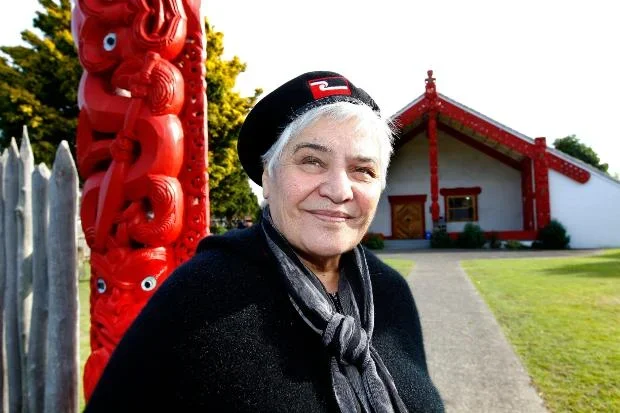
She entered as a Labour MP, held Te Tai Hauāuru from 2002, and served across health, housing, social development, and community portfolios. Then came 2004.
When the Labour government proposed vesting ownership of the foreshore and seabed in the Crown — effectively removing Māori customary rights to their own coastline — Tariana Turia said no. Not quietly. She crossed the floor of Parliament to vote against the bill. Helen Clark sacked her from her ministerial role. She resigned from Parliament entirely, triggering a by-election in Te Tai Hauāuru. She contested it as the founding co-leader of a new party — Te Pāti Māori. She won with 92.74 percent of the valid vote. When she returned to take her seat she became the first MP ever to be sworn in with an affirmation in te reo Māori.
That is not someone who put a foot wrong. That is someone who looked at what was being asked of her, decided it was wrong, and burned the bridge behind her.
Te Pāti Māori won four of seven Māori electorates at the 2005 general election. Under Tariana's co-leadership the party negotiated a Confidence and Supply Agreement with the National Government in 2008 — a difficult and contested decision within the movement — and from that agreement came the initiative she had championed for years. Whānau Ora. A framework placing whānau at the centre of their own solutions. Not clients of the state. Not recipients of services. Decision-makers about their own lives.
"The decisions must be made by the family," she said. "Re-empowering the family to take back control over their own situation, to determine the solutions that impact on them."
Today 250 Whānau Ora navigators operate across the country. More than 200 family businesses have been established through Whānau Ora investment. It is one of the most innovative social policy frameworks in Aotearoa's history and it carries her wairua in every part of it.
She also led a comprehensive campaign to reduce tobacco harm — legislation, plain packaging, removal of tobacco displays, smoking cessation support. She fought for rheumatic fever prevention, for housing, for disabled people, for the Whanganui River. In 2017 she was appointed Te Pou Tupua — the human face of Te Awa Tupua, the Whanganui River, given legal personhood. Her whānau said she described it as the most important role of her life.
She retired from Parliament in 2014 after 18 years. She was made a Dame in 2015.
She died on 3 January 2025 at Whangaehu Marae, on the river where she was born. She was 80 years old. Her whānau travelled with her by waka to Pūtiki Marae before bringing her home to Whangaehu. The motu came to say farewell.
Of all she achieved she often said her greatest was her 56-year marriage to George, her six children, and her more than 80 mokopuna. She never thought of herself as a leader — on the River, she would say, that would be whakahihi. The ability to lead resides in everybody. It just needs to be identified and encouraged.
She was gracious. She was tenacious. She was transformative. And she never once apologised for knowing what was right and doing it anyway.
Dame Tariana Turia
(1944 – 2025)
Dame Tariana Turia was born on 8 April 1944 in Pūtiki on the Whanganui River — of Ngāti Apa, Ngā Wairiki, Ngā Rauru, Tūwharetoa, and Whanganui descent. She was raised by a collective of grandmothers, aunties, and mentors who instilled in her high expectations and a simple conviction: do the right thing. She returned to the River throughout her life when she needed clarity. It never failed her.
Before Parliament she was already building. In 1993 she established Te Oranganui Iwi Health Authority in Whanganui — the first iwi-led public health organisation in Aotearoa. In 1995 she led the Pākaitore occupation in Whanganui, a 79-day stand to restore the mana of the Whanganui people, resulting in an agreement that sees iwi co-manage the area to this day. She came to Parliament in 1996 not as someone new to leadership — but as someone who had already been doing it on the ground for decades.