
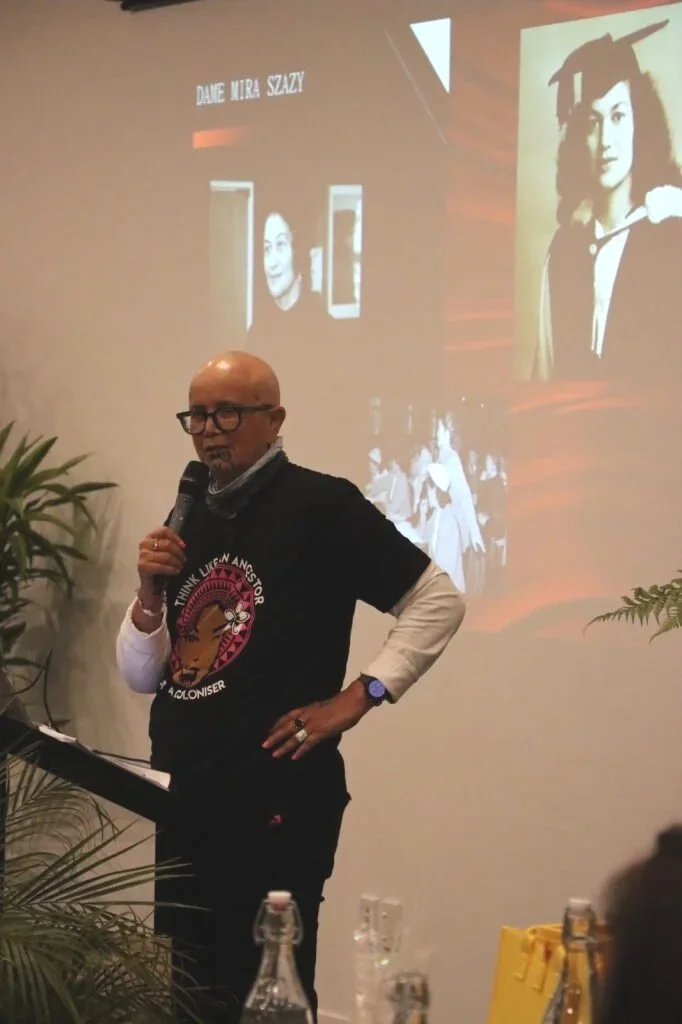
Sharon Hawke
(1962 – 2026)
Our Sharon has gone. And those of us who loved her are sitting with a loss that is both deeply personal and much larger than any one of us." She passed away on 10 April 2026, in Samoa, at the age of 64, far too soon for a woman with so much still to give.
Sharon Ngarongo Hawke. The only daughter of Joe and Rene Hawke. A wāhine of Ngāti Whātua Ōrākei. A takatāpui. A loyal and steadfast friend. A leader in the fullest sense of the word, in the way she lived, the example she set, and the doors she held open for those who came after her.
Shaped by Takaparawhau
Sharon was just thirteen years old when she walked in the 1975 Land March alongside Dame Whina Cooper. It would not be her last act of resistance. Two years later, her whānau's fight became the fight of a generation.
Takaparawhau, their land, the land of Ngati Whatua had been previously confiscated by the Crown, and the Muldoon government was moving to subdivide it and sell it to wealthy private buyers. On 5 January 1977, Joe Hawke and the Ōrākei Māori Action Committee walked onto that hillside and refused to leave. Sharon, fifteen years old, stood with them.
For 506 days they held that ground. When police and army moved in on 25 May 1978, Sharonwas among the 222 people arrested. Fifteen years old, on her own people's land.
Takaparawhau was possibly the crucible in which her sense of purpose was cemented. Her understanding that land, people, and identity cannot be separated, and that fighting for one means fighting for all. She organised commemorations of the occupation each year through to the 45th Year of Resilience gathering in 2023.
Building on What Was Won
The lands returned to Ngāti Whātua Ōrākei, was when she threw herself into the work of rebuilding and growth. She served on the Ngāti Whātua Ōrākei Trust Board and navigating two Treaty claims that addressed some of the wrongs of the past. She was part of the generation that transformed her iwi into a strong, self-determining post-settlement entity,with land, assets, autonomy, and a future.
Her leadership extended well beyond governance. Sharon sat on numerous trusts and boards, bringing her experience, her integrity, and her unflinching commitment to her people to every table she joined.
Telling Our Story
Sharon knew that the occupation's story needed to be documented from the inside, on Māori terms. She picked up the camera with that purpose and, never really put it down.
Inspired by the pioneering Merata Mita who held the distinction of being the only filmmaker trusted by tangata whenua to document the occupation, Sharon became a skilled director, camera operator, and producer in her own right.
In 1998 she edited and produced Takaparawhau – The People's Story. The following year came her documentary Bastion Point — The Untold Story. Ngā Aho Whakaari was a space for wāhine Māori in the screen industry. She directed and filmed numerous other programmes throughout her career, anchored in the belief that Māori stories, told by Māori, could change what people understood about this country and its history.
The Woman We Knew
Sharon was a woman of deep personal warmth. She was fiercely loyal, the kind of friend who showed up without being asked and stayed as long as she was needed. Her door was always open. She was a proud takatāpui wāhine who loved her partner and whanau. She lived and spoke her truth openly, she supported the liberation of her people through their right to benefit directly from the settlements.
She was a passionate champion of wāhine Māori rights, their place in leadership, in governance, in the telling of their own stories. On the water, she was a dedicated waka ama paddler, finding discipline, connection, collective strength, and joy. And always, there waswaiata. It was how she arrived somewhere, how she honoured the moment, how she entertained and brought people together.
Haere Rā, e hoa
Sharon left us in Samoa on 10 April 2026. She was brought home to Takaparawhau — the land she had stood on as a girl, been arrested on as a young wāhine, and poured the rest of her life's energy into building. She was farewelled at Ōrākei Marae and laid to rest at the iwi urupā at Ōkahu Bay. On the whenua. Where she always belonged.
Joe left us in 2022. Rene in 2024. And now Sharon 2026.
We will miss her laugh, her voice in waiata, the way she made every room feel more complete. She was our sister, our friend, our wāhine toa. She marched at thirteen and she never stopped. She loved fiercely, led humbly, and showed us every day what it looks like to live with both purpose and joy.
The Hawke whānau gave their all to and for the people and the land so they would be kept together in perpetuity. Job well done.
Go well, Sharon. You are with your mum and dad now.
Haere, e hoa. Haere ki ōu mātua, ki ōu tīpuna.
Go, friend. Go to your parents, to your ancestors.