
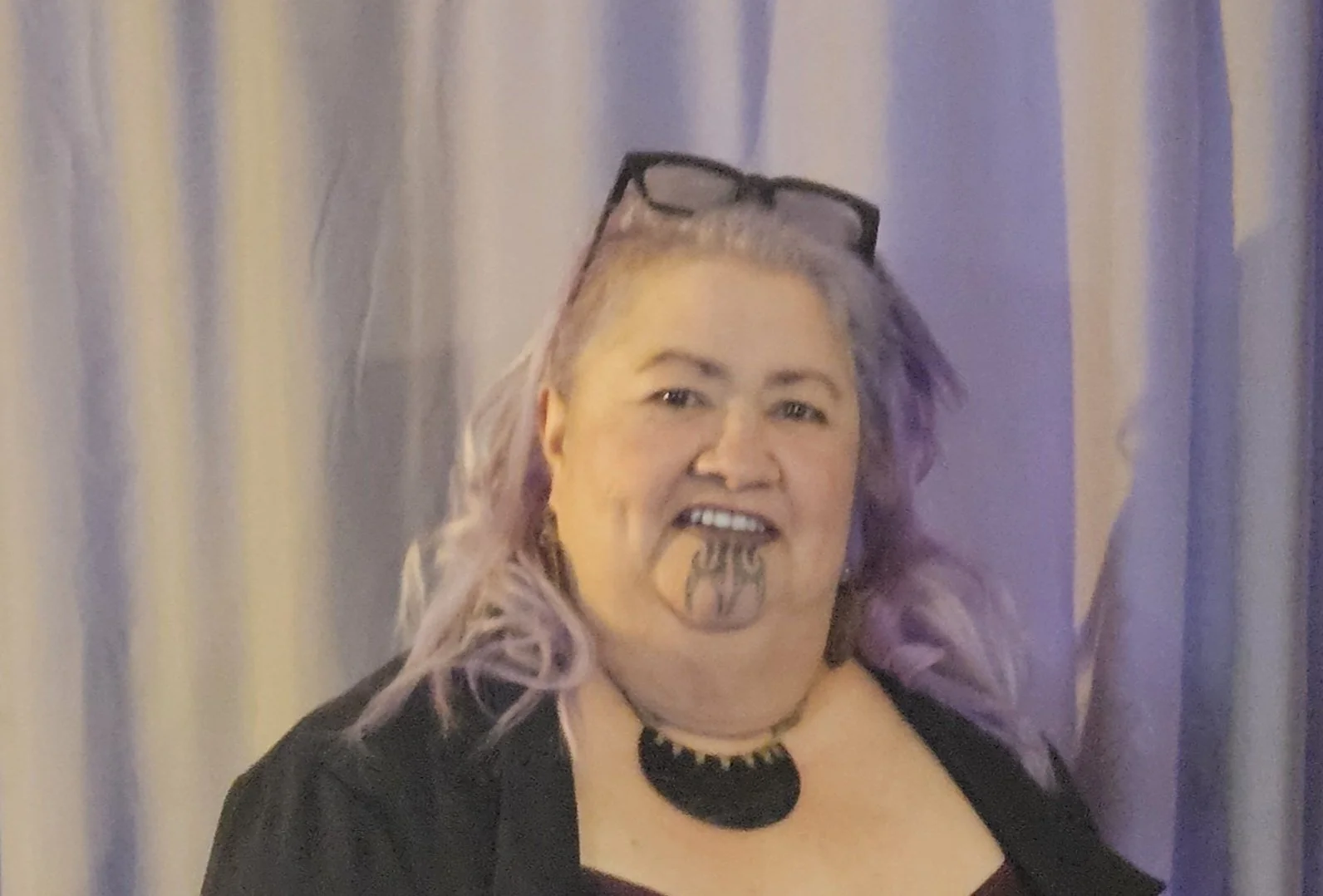
Dale Rewha
Ko Rakaumangamanga te Maunga
Ko Ipipiri te Moana
Ko Ngatokimatawhaorua te Waka
Ko Te Rawhiti te Marae
Ko Ngati Kuta te Hapū
Ko Te Whare Tapu O Ngāpuhi e tū nei
37 years in the movement. Still walking the talk.
Dale grew up in Twizel at the foot of Aoraki — one of a handful of Māori families in a small, predominantly Pākehā, Catholic community. Her father had made his way south from Rawhiti in the far north, found work on the hydro dams, and built a safe home far from his tūrangawaewae. People often assume Dale does this work because of violence at home. It wasn't that. Her father modelled what safety looked like — quietly, consistently, every day.
Her first encounter with family violence was at ten years old. Sent across the road to check on a neighbour, a man answered the door with his wife in a headlock. Before Dale could get back to her own front door, the woman had jumped out of her bedroom window and beaten her there. Her father came. He was calm. He told the man to go home. That was that.
That moment never left her.
"Being nonviolent is a way of life. Not just physical violence — verbal violence. All of it. And it takes a lot to live like that."
At sixteen, Dale became a mother. The Domestic Purposes Benefit came in on the 31st of March 1982. Her daughter was born on the 29th of April. Those few weeks meant she could keep her. She kept her. By eighteen she had bought her first home on a $3,000 deposit, was part of the kōhanga reo movement, and was growing herself alongside other Māori mothers.
At twenty-two she walked into her first role in the sector sideways — asked to mind the phones at Te Puna Oranga while the team went to Wellington. Someone walked in off the street. She answered the door. That was the beginning. She trained as an ACC approved sexual abuse counsellor, started doing crisis line callouts at Women's Refuge, made beds, showed up at all hours. Voluntary. Just because it needed doing.
She talks about those early years with warmth — Mellow Yellow, a tiny van carrying women to safety in the middle of the night, pagers on belts, a brick of a cellphone with a long aerial. "There wasn't a whole lot of compliance," she says, "but there was a whole lot of camaraderie." The sisterhood was real and built on trust.
She is clear she didn't build any of this alone. Alva Pomare and Mereana Pitman trained her at Te Puna Oranga and were among the first to ignite her passion for the emancipation of wāhine Māori. Nan Bachelor was an on-site grandmother presence at the refuge. Auntie Hellen Kaui showed her what it looked like to hold an organisation together. Aunty Kiwa Hutchins was instrumental across refuge and the Ministry of Education. When she went north she trained under Hinewairangi and was shaped by teachers and elders she still names with reverence. Her sisters Glenys and Waiaria walked alongside her through decades of the movement and co-founded their whānau business Rewha-Re with her. "I've been really privileged," she says, "to have some amazing people in my learning."
In 2009, Dale made a choice — to go home. She moved to Kaitaia, reconnected with her whānau in Rawhiti, and closed a gap that had been open her whole life. She became Education Manager at Far North REAP for ten years, managing sixteen staff and servicing 27 secondary schools. It was here she had input into creating the Tikanga Mātua programme — taking parents who had never been to Waitangi, putting them on a van, and driving them there. "There is nothing like standing on the whenua," she says. The programme named colonisation directly and asked whānau — do you want to stay exactly where the Crown designed for you to be?
She came back to Christchurch when her son got unwell. She was only meant to stay a year. Six years later she is still at Te Whare Hauora, rebuilding systems and getting the structures right so the mahi can happen the way it should.
What she is known for
37 years in the refuge movement — one of the wāhine who built the sector others work within today.
Māori Core Group Representative for the South Island — a voice for Māori wāhine at a national level within the refuge movement.
The Christchurch Family Safety Team — sat on the governing board when Christchurch was a pilot site, helping design systems that became a national model.
National Standards of Practice — part of the team who developed the standards that now guide Women's Refuge practice across Aotearoa.
The Tikanga Mātua programme — instrumental in creating this kaupapa Māori education programme built on re-indigenising whānau and reclaiming identity.
By Māori, for Māori — clear and unapologetic. Their resources are for Māori. The movement knows her for this.
When asked what she is most proud of, Dale pauses. "The kūmara never says how sweet it is," she says. But then she says it. Her kids. Her mokopuna. Her grandson — four and a half years old — already the peacemaker in his classroom. Her grandchildren growing up in homes where they don't know what violence looks like.
"It is possible to live a violence free life. Even with all the chaos around us."
That is the work. That has always been the work.
The values she leads by — whanaungatanga, manaakitanga, rangatiratanga, kaitiakitanga, tikanga, kotahitanga — are not words on a wall. They are how she shows up every single day. And what she wants every wāhine Māori to know is simple:
"That as wāhine Māori we can achieve all that we can imagine."