
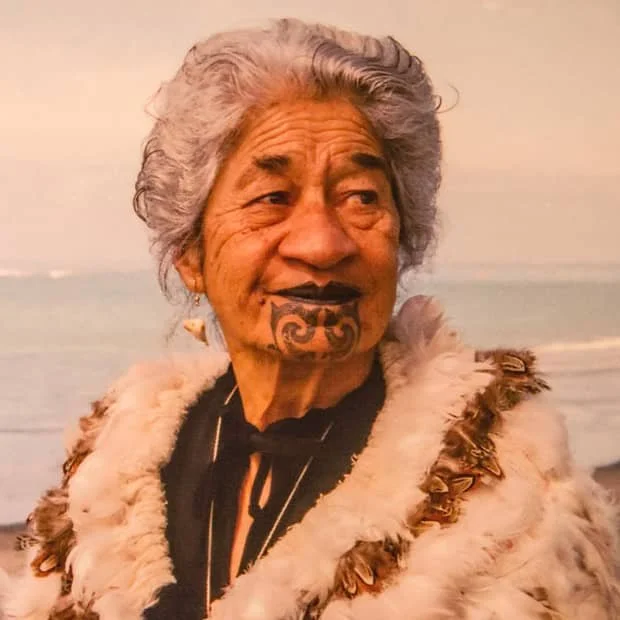
Eva Rickard
(1925 – 1997)
Tuaiwa Hautai Rickard was born at Te Kōpua, Raglan on 19 April 1925 — the eighth of fifteen children. She attended Raglan Primary School where she was given the English name Eva and forbidden from speaking te reo Māori. That detail alone tells you something about the world she grew up in. And the world she spent her life fighting against.
She was not a politician. She was something else — a direct actionist, a land rights warrior, someone who understood that the system would not return what it had taken unless you put your body in the way of it.
The battle that defined her began with land. During the Second World War, the New Zealand Government took land from Tainui Awhiro for a military airfield. When the war ended, the land was not returned. Instead, a 62-acre block was turned into a public golf course in 1969. Eva Rickard spent years fighting to get it back. In 1978 she was arrested during a sit-in protest — the television images of her arrest travelling across the country and stopping people in their tracks. The campaign worked. In 1979 the land was returned to Tainui Awhiro. The golf course became a farm, with a marae and training centre built on it.
The consequences of that victory rippled outward. Alongside the Bastion Point occupation, it led to lasting legislative change — if land taken for public works is no longer needed, the government is now required to return it to the original owners. That is not a symbolic win. That is a law that exists because Eva Rickard and others refused to move.
In February 1984 she led a 2,000-strong hīkoi to Waitangi, demanding an end to Waitangi Day celebrations until all Treaty grievances were settled. She founded Mana Māori in 1993 — believing, when Mana Motuhake joined the Alliance, that an independent Māori political voice was still needed. The electoral system never suited her the way the frontline did. In 1996, in her final years, she reaffirmed rangatiratanga over the land at Whāingaroa by proclaiming it an independent state. Not a metaphor. An act.
She was also a fierce advocate for the rights of wāhine within Māoridom itself — calling for the right of wāhine to speak at official Māori gatherings, including on the marae. This put her in tension with some within her own world, not just with Pākehā institutions. She did not choose her battles for convenience.
She died on 6 December 1997.
At her official tangi, when activist Annette Sykes stood to speak, she was met with cries of "you sit down, you have no right to speak." The sharp irony is not lost — that the battle Eva Rickard had spent her life fighting for wāhine Māori had not been fully won, even in the room where they were saying goodbye to her.
Eva Rickard did not work within the system. She worked against it, around it, and in spite of it — and she got land back. That is a different kind of legacy from those who sat in Parliament. Neither is lesser. Both were needed.
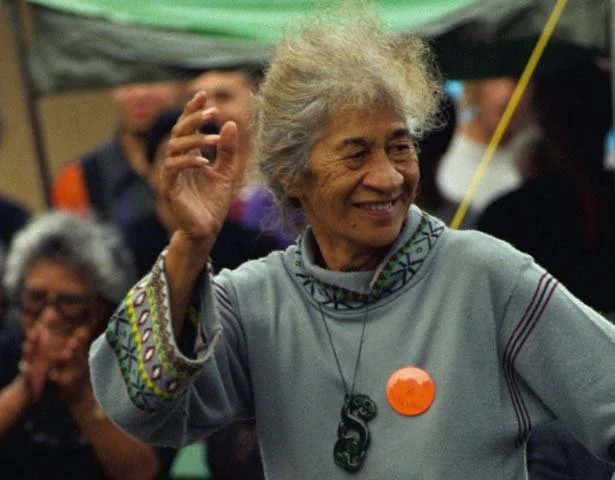
Eva Rickard
uaiwa (Eva) Rickard (Ngāti Koata, Ngāti Toa, Tainui, Taranaki), was born in 1925 at Te Kōpua, Raglan. She is perhaps best known for leading the 1978 Raglan golf course protest.

First female Māori MP electeda space created with rangatahi, for rangatahi. Find support here for your hauora, identity, culture and mental health.