
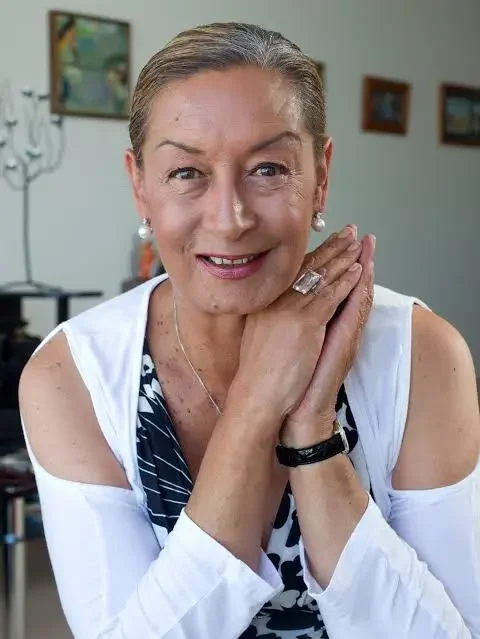
Georgina Beyer
(1957 - 2023 )
… as elected to the Carterton District Council in 1993, and in 1995 she was elected Mayor – the world’s first openly transgender Mayor. She won again in 1998, with 90 per cent of the vote. She resigned this position after she was elected as the Member of Parliament (MP) for the Wairarapa electorate in 1999 as a Labour Party candidate in Helen Clark’s government, winning by a margin of 3,033 votes. Both victories were in conservative rural electorates and surprised many pundits.
In her maiden speech she said:
“I am the first transsexual in New Zealand to be standing in this House of Parliament. This is a first not only in New Zealand, ladies and gentlemen, but also in the world. This is an historic moment. We need to acknowledge that this country of ours leads the way in so many aspects. We have led the way for women getting the vote. We have led the way in the past, and I hope we will do so again in the future in social policy and, certainly, in human rights.”
In 2001, she was the focus of a documentary film called Georgie Girl, which won several international awards. She won her seat in Parliament again in 2002 with an increased majority and spoke passionately on the passing of the Prostitution Reform Act 2003, which decriminalised prostitution in Aotearoa New Zealand. Due to her influence, it passed with 60 votes for, 59 votes against, and one abstention.
She supported use of the Māori language by government and public institutions and was instrumental in the passage of the Māori Language Act 2003, which established the Māori Language Commission and provided funding for the promotion and preservation of te reo Māori. She also championed the Civil Union Act 2004, which legalized civil unions for same-sex and opposite-sex couples, at a time when gay marriage wasn’t an available option in Aotearoa New Zealand. She famously upbraided a religious group who had assembled in protest outside Parliament, saying:
“I’m going to come and look at each and every one of you. I don’t mind at all. How dare you use the cloak of Christianity when you are imparting to your children, prejudice and discrimination toward people like me?”
Fellow MP Grant Robertson walked that line with her. “With a mixture of awe and genuine fear for her safety, I saw the very best of Georgina that day.”
Georgie resigned from Parliament in February 2007. The passing of controversial foreshore and seabed legislation in 2004, which gave the Crown ownership of the public foreshore and seabed, created immense conflict for her as a Māori representing a general seat. She asked to abstain from voting but was refused. She said:
“I pinpoint that period as being the beginning of the end of my parliamentary career. It was the nail in the coffin for me, even though I didn’t leave until a couple of years later, in 2007.”
By 2010 Georgie was struggling financially, and in 2013 was diagnosed with kidney failure. She received kidney dialysis four times a day, seven days a week, until she received a transplant in 2017.
Georgie was the first person of Māori descent to address the Oxford Union on 23 October 2018, and was appointed a Member of the New Zealand Order of Merit (MNZM), for services to LGBTQIA+ rights.
“I’m proud that this is another feather in the cap for the rainbow community and the transgender community, but it wouldn’t have happened without the people of Wairarapa. Rural, conservative people who overlooked my colourful past, looked at the substance of me, and gave me a shot.”
Georgie passed away on 6 March 2023 at the age of 65. The current MP for Wairarapa, Kieran McAnulty, who had been babysat by Georgie as a child, remembered her fondly.
“She was always kind and supportive, and always laughing and having fun. We have lost a great one.”